Cheque Scams

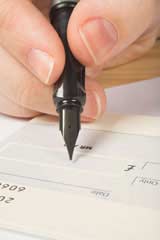
A cheque has always seemed to be a very proper form of payment for goods and services. We write them and receive them, put them in the bank, and assume that because it's written on a piece of paper, the money is really there. But cheques are as susceptible to scams as anything else, and cheque fraud keeps rising. In the first six months of 2004, for example, it rose 50% over the same period on the previous year, costing a staggering £24.3 million.
How Cheque Scams Work
There's more than one type of cheque scam. It can be as simple as a cheque drawn on an account that no longer exists, or one where the writer knows there are insufficient funds to cover the cheque. You won't find out for a few days, until it's gone through the clearing system and has been returned to your bank. By then you might have dispatched the goods for which you'd been paid.There are also forged cheques and bankers' drafts, in which the original amount of the cheque has been altered (this is similar to the advanced-fee fraud, or Nigerian scam). You'll be overpaid for an item or service with the forged cheque, and asked to give the writer the overage. You do so, only to discover several days later that you're a victim.
Perhaps the most typical scam is the stolen chequebook. Once stolen, cheques are written on the account, and the holder might not know until receiving a phone call from the bank about the activity, trying to withdraw money only to find none remains, or until he receives his monthly statement.
How To Avoid Being A Victim
- Don't accept a cheque or bankers' draft as payment unless it's from someone you know well and trust. Be especially careful if the cheque is for a high-ticket item.
- If you're selling a high-value item, insist on Internet or telephone banking instead of a cheque. Another alternative is to use CHAPS. You have to pay (or can arrange to split costs with the other party), but it's very secure, and payment is same-day, rather than the usual clearing period.
- If you choose to accept a cheque, insist on waiting until it's fully cleared and you're sure the money is legitimately in your account.
- Keep your own chequebook in a safe place and report any missing cheques to your bank immediately. Always check your bank statements thoroughly.
What To Do If You're A Victim Of Cheque Fraud
Contact your bank and the police immediately. If your chequebook has been stolen, your bank will refund you the amount. However, if you've accepted a fraudulent cheque or money order, your bank is likely to reclaim the funds.How Long Does A Cheque Take To Clear?
Generally, a U.K. cheque takes three days to clear, not counting weekends or bank holidays. On the day it's paid into an account it's sent to the bank's clearing centre. The second day it's sent, electronically and physically to the drawer's bank, and on the third day the money is debited from the drawer's account. However, if the drawer's bank is unable to pay the amount (e.g. insufficient funds) it will be returned by first-class post to the collecting bank, which will not receive it until the fourth of fifth day. So, if you accept a cheque, allow five full working days for it to clear.- The 'Protected Trademarks' Scam
- The Boiler Room Scam: Bogus Stocks and Shares
- Bank Identification or BIN numbers Scam
- HMRC Self Assessment: Phishing Scam
- High Risk Investment Scams
- HMRC Data Loss Scandal
- Fake Tax Experts
- Losing it all at the ATM
- The Church Con
- HM Revenue and Custom Scam
- Office of Government Commerce Scam
- Bank Charge Scam
- Scams And Seniors
- Baby Boomer and Pensioner Scams
- Quiz Show Fraud
- Matrix Scam
- Offshore Investment Scam
- Prime Bank Guarantee Scam
- Property Scam
- Psychic Scam
- Card Skimming Fraud
- Credit Repair Scam
- Pyramid Schemes
- Stock Tip Scams: Pump and Dump

Re: Bank Identification or BIN numbers Scam
The information you have given above is very reassuring, I had 2 calls the first with a withheld number, wher the…
Re: Builder's Scams
I used a builder accredited by the federation of master builders and trustmark. I have now lived for 18 months in a house with no kitchen, an…
Re: Scams And Seniors
Scammed out of £12500 by a builder who has been to court several times. I paid by my debit card, have I any chance of getting compensation. I am…
Re: Vishing Scam
Had a text message this morning form a mobile number saying that I’ve missed a delivery and that I needed to pay 1.50 to R.M. Lucky enough my iPhone…
Re: Vishing Scam
I received an email from Royal Mail regarding a missed letter from HM customs there was a link to reschedule and I clicked on it and it was a form but…
Re: Sky TV Scam
Just a had call from someone for thay for sky calling my my broadband but sky aways asked you got Security question first
Re: Sky TV Scam
Just had a call from a very unsure SE Asian sounding woman who sounded as though she was in an exceptionally busy call centre- very difficult to make…
Re: Sky TV Scam
I’ve just had a phone call from a man claiming to be from sky telling me that he needs me to log into my computer so that he can help me set up my new…
Re: Sky TV Scam
Just had phone call saying my sky broadband wasn't working correctly and could I go to my computer and log into sky There is nothing wrong with my…
Re: Sky TV Scam
I just had phone call but it was from my own number saying they were sending me new box as mine was out of date. The address they had I moved from ten…