Card Skimming Fraud

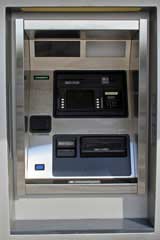
It's something you read about in the news. A person goes to use a hole in the wall cashpoint, and a few days later discovers that his entire bank account has been cleaned out. How did it happen? It's all due to a fairly new hi-tech crime called "skimming" (also known as the "Lebanese Loop"), one that's become more widespread - and hard to detect - in spite of police and bank efforts to combat it. It's a huge business - in 2003 cash machine fraud was worth £61 million.
How It Works
At its heart the scam is quite easy, even if the technique is complex. The thieves attach a false front to the card reader of the automatic teller (i.e. where you insert your card) that captures your card number and transmits it wirelessly to a criminal waiting in a car nearby. They also strategically place another object - possibly a leaflet holder or something else innocuous - on the machine. Inside is a camera that captures your PIN as you type it in. That's either recorded or also transmitted to the waiting person. You withdraw your money, but the next time you use the machine, there have been a number of transactions, which have left your account empty, because the crooks have had a card made with your number on it, used to take cash and buy goods.Variations on that include a keypad cover that captures your PIN to the lo-tech alternative someone standing close by, who looks over your shoulder and memorises your PIN as you enter it. In that case the card reader seems to "swallow" your card, although it's actually just trapped in the fake front for the crooks to retrieve later. There have even been instances of a sign saying a cashpoint was out of order and directing customers to one down the street - which turned out to be a fake.
Handheld card readers, such as in restaurants or shops, can also be used by the unscrupulous to record your card and PIN details.
In America, where there are independent cash machines, there have also been instances of the machine owners using the card information to defraud account owners. That becomes especially worrying, with machine owners being in a position to have regular access to all the information.
How To Prevent It
If the fake parts are manufactured well - and they usually are - this is a crime that can be difficult to detect. However, there are steps you can take to lessen the possibility of becoming a victim.- Wherever possible, always use the same ATM machine, and be very cautious if there are any changes, such as a new leaflet holder. If it's outside a bank (and these criminals will do that), go in and ask about the changes first.
- Use a machine within the bank itself, although that's obviously not always possible.
- Watch out for anyone close by. If they seem too close, cancel the transaction and go to another machine.
- Cover your hand as you enter your PIN by holding your other hand above it.
- Always take your receipt. It doesn't contain your full number, but don't give criminals any information at all.
- Check your account balance regularly If you bank online, that's easily accomplished with a few keystrokes.
What To Do If You're A Victim
- Inform your bank immediately. They can help you change your numbers. In most cases, negotiation will mean you're not liable for funds taken or goods bought with the fake card.
- Check your credit file. Your stolen cash card details can be an entry into identity theft.
- Check the card reader before inserting your card. If you feel tiny prongs, then it's a false front. Don't use it.
Chip and pin cards have certainly cut down on this type of fraud, as the chips on cards that are read by machines are much hard to duplicate. However, it has happened, and almost certainly determined criminals will find a way around this technology. The daily withdrawal limit has also helped curb this to an extent - but if it's not detected for several days, your account can still be cleaned out before you know it.
In spite of all this, the vast majority of all ATM transactions have no problems at all. Use a little care, be alert, and you should have no problems.
- The 'Protected Trademarks' Scam
- The Boiler Room Scam: Bogus Stocks and Shares
- Bank Identification or BIN numbers Scam
- HMRC Self Assessment: Phishing Scam
- High Risk Investment Scams
- HMRC Data Loss Scandal
- Fake Tax Experts
- Losing it all at the ATM
- The Church Con
- HM Revenue and Custom Scam
- Office of Government Commerce Scam
- Bank Charge Scam
- Scams And Seniors
- Baby Boomer and Pensioner Scams
- Quiz Show Fraud
- Matrix Scam
- Offshore Investment Scam
- Prime Bank Guarantee Scam
- Property Scam
- Psychic Scam
- Cheque Scams
- Credit Repair Scam
- Pyramid Schemes
- Stock Tip Scams: Pump and Dump

Re: Builder's Scams
I used a builder accredited by the federation of master builders and trustmark. I have now lived for 18 months in a house with no kitchen, an…
Re: Scams And Seniors
Scammed out of £12500 by a builder who has been to court several times. I paid by my debit card, have I any chance of getting compensation. I am…
Re: Vishing Scam
Had a text message this morning form a mobile number saying that I’ve missed a delivery and that I needed to pay 1.50 to R.M. Lucky enough my iPhone…
Re: Vishing Scam
I received an email from Royal Mail regarding a missed letter from HM customs there was a link to reschedule and I clicked on it and it was a form but…
Re: Sky TV Scam
Just a had call from someone for thay for sky calling my my broadband but sky aways asked you got Security question first
Re: Sky TV Scam
Just had a call from a very unsure SE Asian sounding woman who sounded as though she was in an exceptionally busy call centre- very difficult to make…
Re: Sky TV Scam
I’ve just had a phone call from a man claiming to be from sky telling me that he needs me to log into my computer so that he can help me set up my new…
Re: Sky TV Scam
Just had phone call saying my sky broadband wasn't working correctly and could I go to my computer and log into sky There is nothing wrong with my…
Re: Sky TV Scam
I just had phone call but it was from my own number saying they were sending me new box as mine was out of date. The address they had I moved from ten…
Re: Vishing Scam
Ordered an item on eBay, due for delivery next day. Received a text message from 38794 asking me to confirm the contents of the box, as the item was…